The Routledge Dictionary of Egyptian Gods and Goddesses by George Hart is a comprehensive reference work devoted to the gods, goddesses, religious imagery, and divine traditions of ancient Egypt. Designed as both a scholarly dictionary and an accessible introduction to Egyptian religion, the book brings together information about a remarkably complex pantheon whose forms, names, attributes, cult centres, and functions changed across thousands of years of Egyptian history.
Originally published in 1986, the book was substantially revised for its second edition, published by Routledge in 2005. The revised edition includes a completely new introduction, additional deities, expanded information on numerous existing entries, hieroglyphic versions of most divine names, a more comprehensive chronological framework, an updated bibliography, a new map, and additional illustrations.
For readers interested in Egyptian mythology, ancient Egyptian gods, Egyptian goddesses, hieroglyphs, archaeology, and the religious history of the Nile Valley, this dictionary offers an especially useful way to approach a subject that can otherwise seem difficult because of its enormous chronological and geographical complexity.
An Essential Reference on Egyptian Mythology
Ancient Egyptian religion was never a simple system with a single fixed pantheon. Across different periods and regions, particular gods could gain or lose prominence, merge with other deities, acquire new identities, or become associated with different aspects of kingship, nature, death, creation, fertility, wisdom, or the cosmos.
This complexity is one of the central reasons a dictionary such as The Routledge Dictionary of Egyptian Gods and Goddesses is valuable. Instead of presenting Egyptian mythology as a collection of isolated myths, George Hart places the individual deities within the historical and religious environment in which they developed.
The book’s introduction establishes a chronological framework for understanding the evidence. It begins with Predynastic Egypt and follows the development of Egyptian civilization through the Early Dynastic Period, Old Kingdom, Middle Kingdom, New Kingdom, Late Period, Ptolemaic period, Roman period, Byzantine period, and finally the Arab conquest of Egypt in AD 642.
This chronology is particularly important because the religious significance of a deity cannot always be separated from the historical period in which that deity was worshipped.
George Hart and the Study of Ancient Egypt
George Hart is the author of The Routledge Dictionary of Egyptian Gods and Goddesses. The book identifies Hart as having worked as a staff lecturer and educator on the Ancient Egyptian collections in the Education Department of the British Museum. He later became a freelance lecturer and writer.
His experience with Egyptian collections and archaeological material is reflected in the book’s approach. Rather than treating mythology simply as a collection of stories, Hart examines the evidence through texts, inscriptions, archaeological objects, artistic representations, religious monuments, and historical developments.
The revised edition also benefited from contributions associated with the British Museum. Nigel Strudwick produced the hieroglyphs for most of the gods’ names, while archaeological illustrator Garth Denning contributed a new map and additional drawings.
The result is a reference work that combines textual information with visual and chronological tools.
From Predynastic Egypt to the Great Dynasties
One of the strengths of the introduction is its attempt to show how knowledge about Egyptian gods developed from the earliest surviving archaeological evidence.
The Predynastic period presents particular difficulties because the interpretation of religious imagery is often uncertain. Archaeological discoveries from Naqada II and Naqada III include painted pottery, ceremonial palettes, standards, and other objects containing images that may relate to religious beliefs and divine figures.
The book discusses ceremonial palettes as particularly important sources. Originally, palettes were utilitarian objects used for grinding pigments, but some later developed into elaborately carved examples containing imagery associated with political power, divine kingship, and possibly particular gods.
With the emergence of hieroglyphic writing toward the end of the Predynastic period, the identification of divine figures became more reliable. Ivory labels discovered at Abydos, dating to approximately 3400 BC, provide some of the earliest written evidence that can help identify names and religious concepts.
This transition from uncertain imagery to identifiable written names is fundamental to the study of Egyptian religion.
Horus, Osiris, Seth, Ra, and the Divine Kingship
Among the most important themes introduced in the book is the relationship between Egyptian religion and kingship.
Early objects from the First and Second Dynasties already provide evidence for gods such as Horus, Neith, Khentamentiu, Osiris, and Wepwawet. The material from Abydos is particularly significant because it demonstrates how religious concepts were intertwined with royal authority.
The Narmer Palette provides an especially striking example. Its imagery has traditionally been interpreted in connection with the conquest of Lower Egypt, but it also contains important religious symbolism. The book discusses the representation of Horus and the possible presence of Bat or Hathor imagery, as well as the representation of the king through powerful animal forms.
Such objects demonstrate why Egyptian mythology cannot be studied separately from Egyptian political history. The pharaoh was not merely a political ruler. Egyptian concepts of kingship were deeply connected with the divine world.
The Gods of the Old Kingdom
The Old Kingdom, particularly the period associated with the great pyramids, provides an enormous increase in surviving evidence concerning Egyptian gods and goddesses.
The construction of the Step Pyramid of Djoser around 2650 BC marked a major development in Egyptian architecture, while the tombs of kings and high officials preserved an extraordinary quantity of religious inscriptions and imagery. The Old Kingdom encompassed Dynasties III through VI and witnessed the height of Pyramid Age architecture.
Funerary traditions reveal the importance of gods such as Anubis and Osiris. These deities were associated with the protection of tombs and the provision of everything required for existence in eternity.
Other major gods and goddesses also appear prominently in Old Kingdom sources. Ra, the sun god, Thoth, associated with wisdom, Ptah, the creator god of Memphis, and Min, associated with procreativity, all had important religious traditions. Hathor and Neith likewise appear in evidence concerning the religious practices and devotional lives of women.
The dictionary therefore gives readers an opportunity to see individual deities within the broader religious landscape of ancient Egypt.
The Pyramid Texts and the Egyptian Afterlife
Few sources are more important for understanding ancient Egyptian religion than the Pyramid Texts. The book explains that the earliest surviving examples are found in the pyramid of King Wenis of Dynasty V at Saqqara and date to approximately 2350 BC.
These inscriptions constitute one of the world’s earliest extensive bodies of religious literature. They contain offering rituals as well as a complex collection of theological statements and divine names.
The texts reveal several manifestations of the solar creator, including Ra-Atum, Ra-Harakhti, and Khepri. They also emphasize the king’s journey to the realm of the sun god and his transformation into one of the star gods. The sky goddess Nut plays an important protective role, while the struggle between Osiris and Seth provides an important mythological framework for understanding the deceased king as Horus.
For anyone studying Egyptian mythology and the afterlife, these traditions are essential. They demonstrate that Egyptian religious thought was not simply concerned with the gods themselves but also with the transformation of the deceased and the continuation of existence beyond death.
The Middle Kingdom and the Rise of Amun
The book continues its historical survey into the Middle Kingdom, following the reunification of Egypt under Mentuhotep II in 2055 BC.
Compared with the Old Kingdom, fewer monumental sources concerning deities survive from the Middle Kingdom. However, the surviving evidence is sufficient to demonstrate the importance of gods such as Montu and, increasingly, Amun at Thebes and Karnak.
Evidence from tombs, inscriptions, stelae, and religious monuments also helps reconstruct the importance of Osiris and his festivals.
This historical perspective is important because the Egyptian pantheon was continually evolving. A deity’s importance was not necessarily permanent. Political centres, royal patronage, temples, local traditions, and changing religious ideas could all influence which gods became prominent.
Hieroglyphs and the Names of Egyptian Gods
One of the particularly useful features of the second edition is the inclusion of hieroglyphs for most of the gods’ names.
For students and readers interested in Egyptian hieroglyphs, this addition makes the dictionary more than a simple collection of mythological definitions. Egyptian divine names were part of the visual and religious language of the civilization, and seeing those names in hieroglyphic form helps connect modern readers with the original textual evidence.
The revised edition’s inclusion of hieroglyphs was made possible through the work of Nigel Strudwick of the British Museum’s Department of Ancient Egypt and Sudan.
The dictionary also contains a concordance of divine names, making it easier to approach the many different names and forms encountered in Egyptian religious sources.
A Dictionary Supported by Chronology and Maps
Another major advantage of The Routledge Dictionary of Egyptian Gods and Goddesses is that it does not leave the reader alone with alphabetical entries.
The second edition contains an expanded time chart and a map of Egypt. The chronology covers the development of Egyptian civilization from the Predynastic period through the dynasties of the pharaonic era and into the Ptolemaic, Roman, Byzantine, and early Islamic periods.
This allows readers to place religious developments in geographical and historical context.
For example, understanding the importance of Amun requires awareness of Thebes and Karnak, while understanding Khnum and Satis requires attention to the Nile Cataracts. Similarly, the cults of Osiris, Horus, Ptah, Ra, and other deities cannot be fully understood without considering their associated cult centres and historical periods.
Who Should Read This Book?
The Routledge Dictionary of Egyptian Gods and Goddesses is particularly suitable for students of Egyptology, ancient history, archaeology, religious studies, mythology, and classical civilization.
It is also useful for general readers who are fascinated by ancient Egypt but want something more substantial than a basic introduction. Readers interested in museums, archaeological collections, Egyptian temples, hieroglyphic inscriptions, and the history of religious ideas can use the dictionary as a practical reference while exploring these subjects.
Because the book combines dictionary entries with a historical introduction, chronology, illustrations, hieroglyphs, further reading, and a concordance of divine names, it can function both as a book to read systematically and as a reference volume to consult repeatedly.
The Structure of the Second Edition
The contents of the second edition reflect this dual purpose. Following the preface and outline time chart, the book presents a substantial introduction before beginning the main dictionary. The dictionary section starts on page 11, followed by selected further reading and a concordance of divine names.
The revision was not merely a reprinting of the original work. Hart explains that the new edition contains a completely new introduction, four additional deities, expanded information on a number of other deities, a more comprehensive time chart, and an updated selection of further reading.
These changes make the second edition especially valuable for readers looking for an updated version of Hart’s original dictionary.
Why The Routledge Dictionary of Egyptian Gods and Goddesses Matters
The enduring appeal of Egyptian mythology comes partly from its extraordinary visual richness. Falcons, jackals, crocodiles, scarabs, bulls, lions, cows, and other animals appear throughout Egyptian religious imagery, while gods could be represented in human, animal, or composite forms.
Yet behind this fascinating imagery lies a highly sophisticated religious tradition. Egyptian gods were connected with creation, the sun, the Nile, fertility, death, kingship, wisdom, protection, sexuality, healing, the heavens, and the renewal of life.
Hart’s dictionary provides a framework for navigating this enormous world.
Rather than reducing Egyptian mythology to a collection of familiar names, the book demonstrates how the religious traditions of Egypt developed through archaeological evidence, written sources, artistic representations, royal ideology, funerary practices, and temple cults. Its chronological approach also makes clear that Egyptian religion was not static but changed over thousands of years.
For readers who want to understand why figures such as Ra, Osiris, Isis, Horus, Anubis, Thoth, Hathor, Amun, Ptah, Seth, and many lesser-known deities occupy such important places in Egyptian history, this work provides an informative point of entry.
Download The Routledge Dictionary of Egyptian Gods and Goddesses (PDF)
The Routledge Dictionary of Egyptian Gods and Goddesses by George Hart is a valuable reference for anyone seeking a deeper understanding of the religious imagination of ancient Egypt. Its combination of historical context, dictionary entries, hieroglyphic names, chronology, illustrations, map, further reading, and concordance makes it considerably more useful than a simple alphabetical list of gods and goddesses.
The second edition, published by Routledge in 2005, represents a substantial revision of Hart’s original 1986 work. It expands the scope of the dictionary while providing readers with additional tools for understanding the archaeological and textual evidence behind Egyptian religion.
For students, researchers, Egyptology enthusiasts, mythology readers, museum visitors, and anyone fascinated by the ancient Nile civilization, The Routledge Dictionary of Egyptian Gods and Goddesses offers an illuminating guide to one of the most intricate religious traditions of the ancient world.
Whether used from beginning to end or kept nearby as a reference, the book opens a path into a world in which gods and goddesses were not merely characters in myths, but fundamental forces woven into the Egyptian understanding of nature, kingship, death, creation, and the eternal order of the universe.
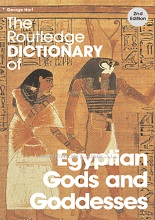
کتاب «The Routledge Dictionary of Egyptian Gods and Goddesses» اثر جورج هارت یک فرهنگنامه جامع درباره خدایان و الهههای مصر باستان است که نخستینبار در سال ۱۹۸۶ منتشر شد. این ویرایش علاوه بر مدخلهای بهروزشده و چهار ایزد جدید، مقدمهای تازه، نام بسیاری از خدایان به خط هیروگلیف، جدول زمانی گستردهتر، نقشه مصر باستان، تصاویر و کتابنامه بهروزشده دارد. کتاب ابتدا تاریخ و منابع مطالعه ادیان مصر باستان را از دوره پیشادودمانی بررسی میکند و سپس با ورود به بخش فرهنگنامه، اطلاعات مربوط به خدایان و الهههای گوناگون را در اختیار خواننده قرار میدهد. این اثر برای علاقهمندان به اسطورهشناسی مصر، تاریخ مصر باستان، باستانشناسی، ادیان باستانی و هیروگلیف منبعی بسیار ارزشمند محسوب میشود.
برای دانلود این کتاب، ابتدا باید عضو سایت بشوید.
پس از عضویت، لینک دانلود این کتاب و همهی کتابهای سایت برای شما فعال میشوند.
(قبلا عضو شدهاید؟ وارد شوید)