


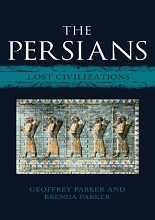
The Persians: Lost Civilizations is an insightful, accessible, and well-researched exploration of one of humanity’s oldest and most influential civilizations. Written by Geoffrey Parker and Brenda Parker and published by Reaktion Books in 2017, the book serves as both a historical guide and a cultural portrait of the Persian world—from its earliest roots in ancient Iran to its lasting global legacy. Spanning sixteen chapters, the narrative blends archaeology, historiography, religion, art, and political history in a way that invites both specialists and general readers to re-examine what “Persia” has meant across millennia.
At its core, the book argues that although much of ancient Persia may seem “lost” to the modern world, its presence continues to shape global culture, politics, religion, identity, and collective memory. The authors take readers on a sweeping journey across geography and time, revealing how the Persian civilization continually re-emerged despite invasions, dynastic shifts, cultural transformations, and ideological revolutions.
A Land Shaped by Geography and Movement
The opening chapters focus on the strategic geography of the Iranian plateau—a landscape defined by towering mountain ranges, arid deserts, fertile plains, and river-fed lowlands. These natural features not only influenced patterns of settlement, warfare, and agriculture, but also shaped the cultural and political unity of the region. The authors explain how a diverse range of peoples—Elamites, Medes, Persians, and other Indo-European groups—migrated into the area over centuries, gradually forming the foundation for what would become the Persian identity.
By introducing early civilizations such as Elam and their capital at Susa, the book places Persia firmly within the broader context of Mesopotamian development. This early chapter helps the reader appreciate that long before the Achaemenid Empire emerged, Iran had been home to vibrant societies with deep cultural roots.
The Rise of the Achaemenid Empire
Arguably the heart of the book lies in its detailed exploration of the Achaemenid Empire, the first great Persian world-state. Under Cyrus the Great, the Persians expanded from a small group in the region of Pars (Fars) into a vast empire stretching from the Mediterranean to the Indus Valley. Through clear and engaging storytelling, the authors highlight the innovative political and administrative systems that Cyrus and later Darius I established—systems that would influence countless empires after them.
Cyrus is portrayed not only as a conqueror but as a statesman who respected the cultures, laws, and religions of conquered peoples. His liberation of the Jews from Babylonian captivity and his model of imperial governance are presented as early examples of what we might today call tolerance or multicultural administration.
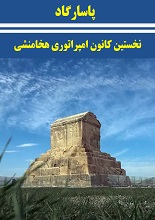
The book also provides a compelling account of the empire’s infrastructure: the Royal Road, postal systems, satrapies, standardized currencies, and monumental architecture including Pasargadae and Persepolis. These achievements demonstrate how the Persians built a functioning, coherent, and enduring imperial system in a world that had rarely known such scale.
Religion, Thought, and Cultural Influence
One of the most fascinating parts of the book is its discussion of Zoroastrianism and the teachings of Zarathustra (Zoroaster). The authors examine how ideas of cosmic dualism, moral responsibility, and divine justice influenced not only Persian society but also major world religions such as Judaism, Christianity, and Islam. In this regard, Persia is shown as a spiritual and philosophical crossroads of the ancient world.
Additionally, The Persians: Lost Civilizations sheds light on the origins of the “paradise garden,” a Persian invention that blended aesthetics, spirituality, and political symbolism. The very word “paradise” derives from the Old Persian term pairidaeza, meaning “enclosed garden.” These gardens became metaphors for peace, order, and divine kingship, influencing later Islamic design and European Renaissance garden culture.
Conflicts with Greece and the Question of Power
The Greco-Persian Wars receive careful treatment, not as a simple East-versus-West narrative, but as a more nuanced geopolitical clash. The authors emphasize how Greek historiography—especially Herodotus—often shaped Western perceptions of Persia as “the other.” While battles such as Marathon, Thermopylae, and Salamis are well known, the Parkers highlight the broader implications of these conflicts: the Persian Empire reached the limits of its westward expansion, and Greek identity was profoundly shaped through opposition to Persia.
From Alexander to the Islamic Era
Subsequent chapters examine the fall of the Achaemenids to Alexander of Macedon, the Hellenistic period, and the revival of Persian power under the Sasanian dynasty. The Sasanians, ruling from AD 226 to 651, are portrayed as guardians of Persian identity, culture, and religion during a time when regional power was shifting dramatically. The authors explain how the Sasanians rivaled Rome and Byzantium, engaged in global trade networks, and contributed to the flourishing of art, architecture, and statecraft.
The arrival of Islam in the 7th century brought another transformation—not a disappearance of Persia, but a reinvention. Persian language, literature, and philosophy, especially during the Islamic Golden Age, became pillars of the broader civilization known today as the Islamic world.
Persia’s Extended Legacy Across Asia
One of the strengths of the book is its demonstration that Persian culture flowed far beyond the borders of present-day Iran. Chapters dedicated to Central Asia and India reveal how Persian art, literature, court culture, and architecture influenced empires from the Timurids to the Mughals. Samarkand, Herat, Agra, and Delhi all reflect the enduring impact of Persian aesthetics and administration.
Modern Iran and the Memory of Empire
The final sections of The Persians: Lost Civilizations bring the story into the modern era. The authors analyze the Pahlavi dynasty’s attempts to revive imperial symbolism, including the grand 1971 celebrations at Persepolis, and then explore how the Islamic Republic has reinterpreted or contested those ancient symbols. Even today, the memory of Cyrus, Darius, and the ancient Persian world continues to play a role in Iranian national identity and global perception.
A Thoughtful and Essential Introduction to Persian Civilization
Overall, The Persians: Lost Civilizations is a thoughtful, well-structured, and richly illustrated introduction to one of the world’s most influential civilizations. It provides readers with a clear narrative of Persian history while also highlighting the cultural, religious, and political legacies that extend across continents and centuries. The book invites readers to reconsider old assumptions, appreciate the complexity of Iran’s past, and understand why Persia continues to matter in the world today.
Download “The Persians: Lost Civilizations”
برای دانلود این کتاب، ابتدا باید عضو سایت بشوید.
پس از عضویت، لینک دانلود این کتاب و همهی کتابهای سایت برای شما فعال میشوند.
(قبلا عضو شدهاید؟ وارد شوید)