



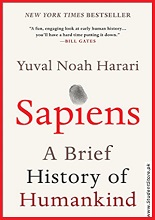
In a world full of history books, few works have achieved the global acclaim of Sapiens: A Brief History of Humankind. Written by Yuval Noah Harari, this groundbreaking book explores the history of humankind from the emergence of Homo sapiens in the Stone Age to the modern age, offering readers a fresh perspective on who we are and how we got here.
Sapiens is more than a historical account; it is an exploration of ideas, cultures, and systems that have shaped human societies across millennia. Its compelling narrative, combined with scientific research and philosophical insights, makes it accessible to both casual readers and scholars alike.
This article provides an in-depth review of Sapiens, covering its themes, structure, major concepts, impact on modern thinking, and why it has become essential reading for anyone interested in understanding humanity.
About the Author – Yuval Noah Harari
Yuval Noah Harari, an Israeli historian and professor at the Hebrew University of Jerusalem, is renowned for his ability to synthesize complex historical, scientific, and philosophical ideas into engaging narratives.
Harari holds a PhD in history from the University of Oxford, and his research focuses on macro-historical processes, particularly the intersections of history, biology, and culture. Sapiens, published in 2011, catapulted him into international fame, with translations in over 60 languages and millions of copies sold worldwide.
Harari’s writing is known for its clarity, depth, and provocative ideas. He challenges conventional wisdom and encourages readers to question assumptions about society, economy, politics, and even human nature itself.
Overview of the Book
The central premise of Sapiens is that Homo sapiens’ success as a species is largely due to our unique ability to create and believe in shared myths and imagined realities. These myths—ranging from religion and money to corporations and nations—allow humans to cooperate flexibly in large groups and build complex societies.
The book explores three major revolutions in human history:
- The Cognitive Revolution (c. 70,000 years ago)
- The Agricultural Revolution (c. 12,000 years ago)
- The Scientific Revolution (c. 500 years ago)
Each revolution reshaped human societies, influencing politics, culture, economy, and our understanding of the world.
Themes
Key themes explored in Sapiens include:
- The evolution of human cognition
- Social cooperation and the role of myths
- The transformation from foragers to agricultural societies
- The emergence of money, empires, and religion
- The impact of science and technology on human progress
- The ethical and existential questions of modern society
Structure
The book is divided into four main parts:
- The Cognitive Revolution
- The Agricultural Revolution
- The Unification of Humankind
- The Scientific Revolution
Each section combines historical evidence, philosophical reflections, and engaging storytelling to illuminate the trajectory of humanity. (download Sapiens: A Brief History of Humankind from author site)
The Cognitive Revolution
The first major revolution described in Sapiens is the Cognitive Revolution, which occurred approximately 70,000 years ago.
During this period, Homo sapiens developed the ability to think abstractly, communicate complex ideas, and create shared myths. These cognitive skills distinguished humans from other species and allowed them to form large, cooperative societies.
Key insights from this revolution include:
- Language and Communication: The emergence of sophisticated language enabled humans to share knowledge, plan collective actions, and coordinate large groups.
- Shared Myths: Myths about gods, spirits, and social constructs allowed humans to cooperate flexibly beyond immediate family or tribal groups.
- Imagination as a Tool: Storytelling and imagination became central to cultural development, facilitating social cohesion and innovation.
The Agricultural Revolution
Approximately 12,000 years ago, humans transitioned from foraging to agriculture, a process that transformed societies worldwide.
Sapiens explains that while agriculture allowed for population growth and settled communities, it also brought new challenges:
- Increased labor and physical strain
- Social hierarchies and inequality
- Spread of diseases due to dense populations
- Environmental changes and land exploitation
Despite its drawbacks, the Agricultural Revolution laid the foundation for complex civilizations, trade networks, and the emergence of empires.
The Unification of Humankind
In the millennia following the Agricultural Revolution, humans began creating large-scale societies connected by trade, empires, religion, and shared ideologies.
Money and Trade
Money, Harari argues, is one of humanity’s most powerful imagined realities. It enabled trust and cooperation between strangers and facilitated complex economic systems.
Empires
Empires unified vast territories under centralized authority, spreading laws, cultural norms, and technological innovations. However, they also imposed control, leading to inequality and conflict.
Religion
Religion played a crucial role in unifying diverse populations. Shared beliefs provided ethical frameworks, social cohesion, and a sense of purpose for millions of people.
The Scientific Revolution
The Scientific Revolution, beginning around 500 years ago, marks the era when humans began systematically understanding the world through observation, experimentation, and reasoning.
Key impacts include:
- Rapid technological advancement
- Transformation of economies and societies
- Expansion of knowledge and global exploration
- Rise of capitalism, industry, and modern science
Harari emphasizes that the Scientific Revolution reshaped humanity’s trajectory, granting unprecedented power but also introducing ethical and existential dilemmas.
Major Concepts and Ideas
Imagined Orders
A central idea in Sapiens is that humans live within imagined orders—social constructs like nations, corporations, and money—that exist only because people collectively believe in them. download Sapiens: A Brief History of Humankind.
Shared Myths
Shared myths allow humans to cooperate flexibly. Unlike other animals, which rely on instinct, humans rely on belief in concepts that cannot be empirically verified.
Capitalism, Religion, and Politics
Harari explores how capitalism, organized religion, and political ideologies operate as systems of shared belief, shaping societies and human behavior.
Impact on Modern Society
Sapiens is not merely historical; it has profound implications for understanding the modern world. It explains:
- Why humans organize into states and corporations
- How cultural norms shape behavior
- The ethical challenges posed by biotechnology, artificial intelligence, and globalization
By connecting the past to the present, Harari encourages readers to reflect on the future of humanity and their role within it.
Critical Analysis and Review
Strengths:
- Engaging narrative and accessible language
- Comprehensive synthesis of history, science, and philosophy
- Provocative insights that encourage critical thinking
Weaknesses:
- Some critics argue Harari oversimplifies complex historical events
- Limited focus on regional diversity and non-Western perspectives in some sections
Despite these criticisms, the book’s strengths far outweigh its limitations, making it a vital read for understanding human history and society.
Why Sapiens is a Must-Read
For anyone interested in history, anthropology, sociology, or philosophy, Sapiens offers:
- A broad understanding of human evolution and culture
- Insight into the forces shaping societies today
- Thought-provoking questions about ethics, progress, and the future
It is both educational and transformative, encouraging readers to think critically about the past, present, and future.
download Sapiens: A Brief History of Humankind
In conclusion, Sapiens: A Brief History of Humankind is a monumental work that combines scholarship, storytelling, and philosophy. Harari’s ability to distill complex concepts into compelling narratives makes the book accessible to a global audience.
Whether you are a student, educator, or lifelong learner, Sapiens challenges you to reconsider what it means to be human and how our species has shaped the world.
برای دانلود این کتاب، ابتدا باید عضو سایت بشوید.
پس از عضویت، لینک دانلود این کتاب و همهی کتابهای سایت برای شما فعال میشوند.
(قبلا عضو شدهاید؟ وارد شوید)