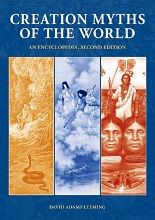
Creation Myths of the World is a book by David A. Leeming. This book is composed of several distinct parts that are nevertheless intricately related. The introduction provides the context and the parameters of the book. It defines myth generally and creation myths specifically, outlining the different types of cosmogonies.
About Creation Myths of the World Book
Part I is a detailed discussion of the basic creation myth types. The use of these types in this book owe much to the work of earlier writers, particularly that, for instance, of the mythologist Joseph Campbell, and three writers who have contributed important works specifically to the field of creation mythology: the psychologist Marie-Louise von Franz, the religious studies scholar Mircea Eliade, and, especially, another religious studies scholar, Charles H. Long. The myths referred to in this section can be found fully retold in Part Two.
Part II is a comprehensive collection of creation myths from around the world. Some are highly complex, some exist now only in fragments. The myths are arranged alphabetically by culture. In each entry the culture is identified briefly, the myth is told and categorized by basic type. A brief commentary, where appropriate, is included, stressing when possible the cultural significance of the myth. Sources and suggested further readings are then listed, followed by a list of terms pointing the reader not only to the essays in Part One, but to the articles in Parts Three and Four.
The articles in Part III expand on themes and motifs that are frequently associated with creation myths around the world, themes such as the dismemberment of a world parent, the presence of animals in creation myths, the Flood as an aspect of creation, and the place of goddesses in creation myths. These articles should provide the reader with a deeper understanding of creation myths in general, of significant relationships between myths of various cultures, and of the particular creation myths themselves in which the themes in question play significant roles.
Part IV is a glossary of significant figures and terms that are found in the myths and in the discussions of the myths. Some of the articles in the glossary are expanded background information that will provide further understanding of many of the most complex creation myths and the cultures out of which they emerged. Part V is composed of a series of charts categorizing the various myths according to types. An annotated bibliography referring to the sources and further readings, and an index follow.
Full reference citations for works referred to by page number in parentheses or at the end of each myth in Part II may be found in the bibliography.
Download Other Books:
The Persians: Lost Civilizations
The Corpus Hermeticum
Love Yourself First
Découvrir la philosophie contemporaine
Reinventing Your Life
Royal Correspondence of the Assyrian Empire
Introduction
In common usage the word “myth” refers to narratives or beliefs that are untrue or merely fanciful; the stories that make up national or ethnic mythologies describe characters and events that common sense and experience tell us are impossible. Nevertheless, all cultures celebrate such myths and attribute to them varying degrees of literal or symbolic truth . Myths are retold orally from generation to generation and/or preserved in sacred collections or scripture, often believed to have emanated from a deity or deities.
Myths are not only the stories of so-called dead cultures and religions such as those of the Ancient Greeks, Romans, Norse, or Egyptians. Extraordinary and supernatural sacred narratives are central to Christians, Jews, Muslims, Hindus, Buddhists, and Taoists, as well as to people of animist traditions to which the terms have traditionally been applied with a negative connotation. Naturally, a story that is true in some sense for one culture is purely, in the common usage, myth to another. People of the Abrahamic religions (Jews, Christians, Muslims) have no trouble describing the impossible acts of the African trickster Anans or the Native American Spider Woman as myths, but their own stories, they say, are Gods truth, not myths. The animist, or for that matter the Hindu, the Jew, or the Buddhist, however, might reasonably call the Christian story of Jesus resurrection a myth: according to common sense and experience people do not rise from the dead. By the same token, the Night Journey of Mohammad from Mecca to Jerusalem on a flying horse can reasonably be considered a myth, as can the Jewish story of the Passover, the Hindu story of the creation of Ganesha, the elephant-headed god, or the story of the Buddhes conception by way of a white elephant in a dream.
What, then, is the relation of myths to reality? How are myths alive even true and not false wheresoever they come from? Clearly myths have had significant power to move people. Societies have defined themselves by, committed themselves to, and even been willing to kill and be killed in support of their myths. There are, of course, fundamentalists in all religions who insist on the literal reality of their myths. But there are others who see in their sacred narratives not literal truth but metaphorical and symbolic power and significance without which their lives would become meaningless, rootless, or even intolerable. In either case, a cultures myths are true to the culture because they are embedded in its psyche, as much a part of its reality as its people and its physical landscape. This truth applies to all sacred narratives, whether those of the ancient Celts, Norse, Greeks, and Egyptians, those of the indigenous peoples of North America and elsewhere, or those of the Hindus, Christians, Jews, and Muslims, or the contemporary practitioners of Wicca.
Perhaps the best way to understand myths is to consider the human role in life itself. It might well be said that what defines us as humans is our need to imitate reality, to tell stories. Of all creatures it seems likely that only we are capable of considering what Aristotle defined as mythos , or plot that which has a beginning, a middle, and an end. In terms of our individual lives, our national and cultural lives, and even the planetary and universal existence itself, we see ourselves as travelers on a path from beginning to end. We turn that awareness into stories, whether consciously in religion and art, or unconsciously in dream. A myth is a religious and artistic narrative; it is also a cultural dream.
In our post-Freudian age few people would suggest that dreams are simply untrue stories unworthy of examination. Rather, to the extent that we believe in the unconscious, we see dreams as metaphorical or symbolic constructs that contain truths about the dreamer. If we see myths as cultural dreams, we naturally take them seriously as sources of information about the inner workings the collective psyche of the culture in question and, by extension and comparison, about the psyche of the human species as a whole.
Each culture springs to life in its own way, in its own place, and develops its own priorities, and it is important to remember that myths, on one level, are cultural rather than universal statements. The universality of myth emerges, however, when we make comparisons between mythologies. Through comparison certain constants appear.
Most mythologies which is to say, religions have deities, most have heroes who perform certain ritual deeds, many of which are found in most mythologies the quest, the descent to the Underworld, for example. Universal patterns or common motifs in mythology have been called archetypal, that is, reflective of psychological tendencies that are common to the human species as a whole. At the archetypal level a story such as the resurrection of Jesus becomes true freed of the parochial restrictions of the merely local when compared to other resurrection stories such as those of Osiris or Persephone. Through comparison, the truth of the story is seen to lie in the concept of resurrection rather than in the individuals who are resurrected. Having said that, it is again important to remember that archetypes those of the heroes quest or the supreme deity or the trickster or the Flood, or creation itself only take on life and meaning when they are clothed in cultural particularity.
Download Creation Myths of the World
برای دانلود این کتاب، ابتدا باید عضو سایت بشوید.
پس از عضویت، لینک دانلود این کتاب و همهی کتابهای سایت برای شما فعال میشوند.
(قبلا عضو شدهاید؟ وارد شوید)